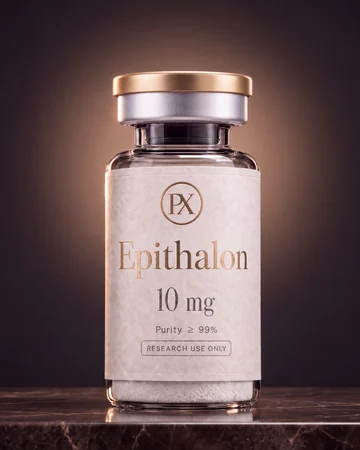
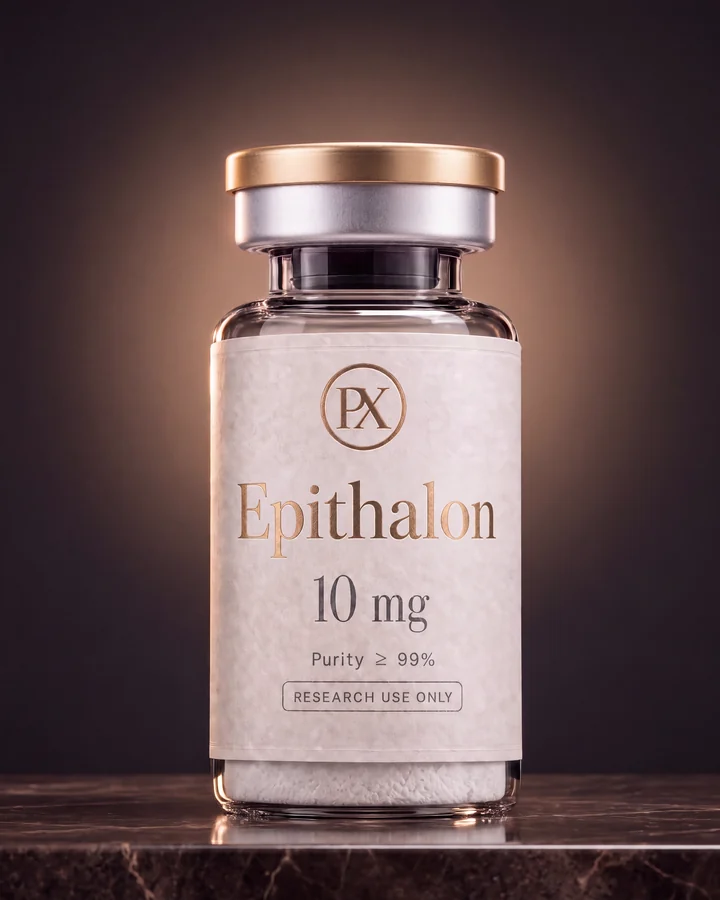
Epithalon Single vial · Cellular Senescence Research
Strength
Coming soon
Price to be confirmed.
For laboratory research use only. Not for human or veterinary use.
Buying at volume? Epithalon factory direct
About Epithalon+
About Epithalon
Epithalon (also spelled Epitalon; sequence Ala-Glu-Asp-Gly, or AEDG) is a synthetic tetrapeptide from Khavinson's short-peptide programme at the St Petersburg Institute of Bioregulation and Gerontology. It was designed from the amino acid make-up of Epithalamin, an extract of cattle pineal gland, and is the most published peptide of this programme. In human fetal lung cells grown in the lab, the developers reported raised telomerase activity, longer telomeres (the caps on the ends of chromosomes) and, in a later paper, extra cell divisions (Khavinson et al., 2003). An independent UK laboratory reported longer telomeres in normal human cells through telomerase, and in breast cancer cell lines through a different route called ALT (Al-Dulaimi et al., Biogerontology 2025). In a lifelong study of female mice (54 per group), average lifespan did not change, while the longest-lived tenth lived somewhat longer. A study led from Paris found no change in melatonin release from young or old rat pineal glands in the lab (Djeridane et al., 2003). Human reports come from the developers' network, mostly in Russian journals, with no published randomised placebo-controlled trials. Long-term safety and whether lab findings apply to people are not known. Supplied for laboratory research use only.
Mechanism
No receptor has been identified for Epithalon. In cultured human cells it was reported to switch on the gene for telomerase (the enzyme that rebuilds chromosome ends) and lengthen telomeres, findings reported by its developers and by an independent UK laboratory (Al-Dulaimi et al., 2025). In rat pineal cell cultures the developers reported more AANAT, an enzyme in melatonin production, but a separate rat pineal study led from Paris found no change in melatonin release. The developers also propose that it binds DNA directly, based on test-tube and modelling work.
Research on Epithalon
Storage and handling
- Sealed and lyophilised, store at 2 to 8°C away from light and moisture. Minus 20°C for longer.
- Once reconstituted, keep refrigerated and avoid repeated freeze and thaw cycles.
- Bacteriostatic water is the usual diluent. The volume added sets the concentration in mg per mL.
- Vials carry a batch number for your laboratory records. Recent independent lab results are published in our COA Library.
FAQs
Can I order a single vial of Epithalon without a minimum order?+
Yes. The single-vial range exists precisely so a laboratory can take one vial of Epithalon rather than a full Factory Direct kit of 10. There is no minimum order quantity on this format.
How quickly does a Epithalon single vial ship in the UK?+
Single vials are held in our UK facility and posted the same day by Royal Mail Tracked 24 when paid by 3pm Monday to Friday. Orders placed after 3pm on Friday are posted on Monday morning.
How does the single vial differ from the factory-direct box?+
The compound and the manufacturing source are the same. The Factory Direct kit is a 10-vial pack and a lower per-vial cost, while the single vial is one vial from UK stock for small-scale or pilot work.
What purity is stated for Epithalon?+
≥99% manufacturer-stated purity. Buyers are encouraged to run independent third-party verification, and our testing directory lists laboratories that perform it.
Is this Epithalon vial for human use?+
No. Every Peptx product, including the single-vial range, is supplied strictly for laboratory research. It is not for human consumption, diagnosis, treatment or any clinical use.
What is Epithalon?+
Epithalon (also spelled Epitalon) is a synthetic four-amino-acid peptide, Ala-Glu-Asp-Gly. It was designed in St Petersburg from the make-up of Epithalamin, a cattle pineal gland extract. It is supplied here for laboratory research use only.
How does Epithalon work?+
No receptor has been identified. In cultured human cells it switched on telomerase, the enzyme that rebuilds chromosome ends, and lengthened telomeres. Its developers also report effects on a melatonin-making enzyme in rat pineal cells, though a separate study led from Paris found no change in melatonin release.
Has Epithalon been tested in people?+
Only in studies from the developers' network, mostly published in Russian, with no published randomised placebo-controlled trials. Most evidence comes from cell cultures, rodents and fruit flies, and long-term safety in people is not known.
How is Epithalon stored?+
Store the freeze-dried powder sealed, cold and away from light, following standard laboratory peptide storage procedures. See the product specifications for detailed storage requirements.
Other single vials in Cellular Senescence Research
Strictly for laboratory research. Not for human consumption, diagnosis or treatment.