
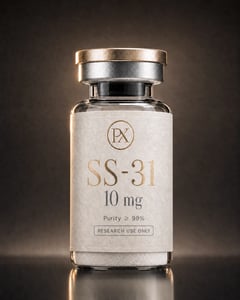
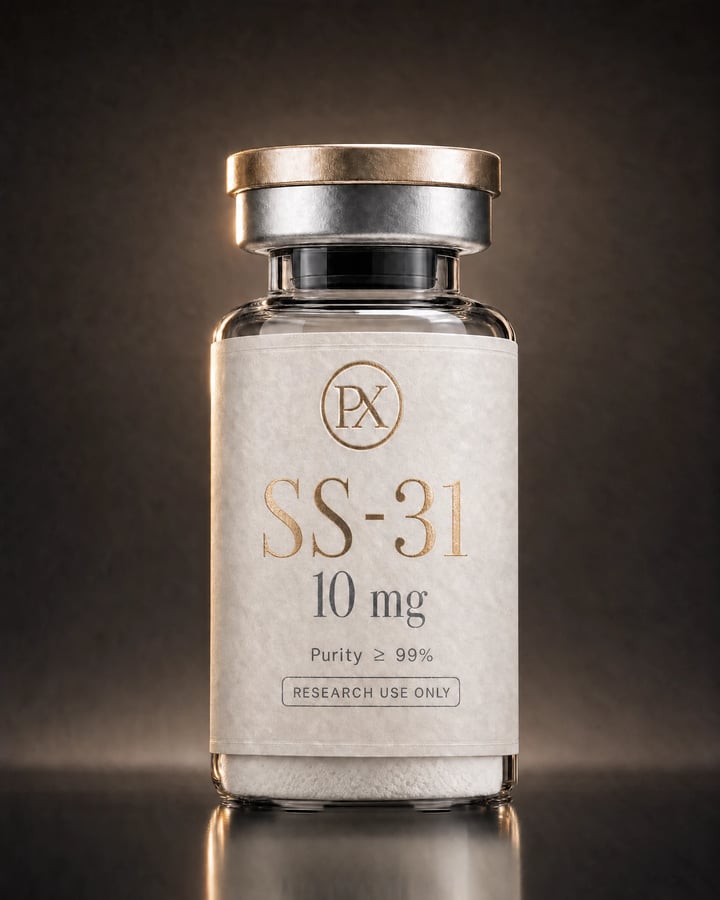
SS-31 Single vial · Cellular Senescence Research
Strength
Volume pricing
Any mix of Express vials counts. Not combined with discount codes.
Add 1 more to unlock 5% off
Your basket is empty
With this one in, 1 vial more of anything and the whole basket is 5% off.
For laboratory research use only. Not for human or veterinary use.
Buying at volume? SS-31 factory direct
About SS-31+
About SS-31
SS-31 (elamipretide; earlier codes MTP-131 and Bendavia) is a synthetic four-amino-acid peptide, D-Arg-Dmt-Lys-Phe-NH2, where Dmt is a modified tyrosine. It is one of the Szeto-Schiller peptides from Szeto's laboratory at Weill Cornell Medical College, and Stealth BioTherapeutics developed it as a medicine. It has been studied widely in cells and animals. A phase 3 placebo-controlled trial in 218 adults with primary mitochondrial myopathy did not meet its primary goals for walking distance or fatigue (Karaa et al., Neurology 2023). In Barth syndrome, a rare inherited disorder of the mitochondrial lipid cardiolipin, a 12-person placebo-controlled crossover trial also missed its primary goals; walking distance was better than at the start during an open-label follow-up with no placebo group (Thompson et al., Genet Med 2021). In September 2025 the US FDA granted elamipretide (as Forzinity) accelerated approval for Barth syndrome, based on knee muscle strength, and requires a further placebo-controlled trial to confirm the result. It is not authorised in the EU. The material supplied here is not the licensed medicine. Supplied for laboratory research use only.
Mechanism
SS-31 carries two positive charges and two ring-shaped (aromatic) groups, which let it enter cells and gather at the inner mitochondrial membrane, where it binds cardiolipin, a negatively charged lipid. In cell, isolated-mitochondria and animal studies this binding was linked to more stable membrane folds (cristae), less production of reactive oxygen species and changes in the membrane's surface charge (Mitchell et al., 2020). How these effects relate to clinical outcomes in people is still being studied.
Research on SS-31
Storage and handling
- Sealed and lyophilised, store at 2 to 8°C away from light and moisture. Minus 20°C for longer.
- Once reconstituted, keep refrigerated and avoid repeated freeze and thaw cycles.
- Bacteriostatic water is the usual diluent. The volume added sets the concentration in mg per mL.
- Vials carry a batch number for your laboratory records. Recent independent lab results are published in our COA Library.
FAQs
Can I order a single vial of SS-31 without a minimum order?+
Yes. The single-vial range exists precisely so a laboratory can take one vial of SS-31 rather than a full Factory Direct kit of 10. There is no minimum order quantity on this format.
How quickly does a SS-31 single vial ship in the UK?+
Single vials are held in our UK facility and dispatched within 24 hours of a cleared payment on working days, on a tracked UK service. Orders placed at the weekend go out on the next working day.
How does the single vial differ from the factory-direct box?+
The compound and the manufacturing source are the same. The Factory Direct kit is a 10-vial pack and a lower per-vial cost, while the single vial is one vial from UK stock for small-scale or pilot work.
What purity is stated for SS-31?+
99%+ manufacturer-stated purity. Buyers are encouraged to run independent third-party verification, and our testing directory lists laboratories that perform it.
Is this SS-31 vial for human use?+
No. Every Peptx product, including the single-vial range, is supplied strictly for laboratory research. It is not for human consumption, diagnosis, treatment or any clinical use.
What is SS-31?+
SS-31 (elamipretide) is a synthetic four-amino-acid peptide that targets the inner membrane of mitochondria. It came from Szeto's laboratory at Weill Cornell Medical College and was developed as a medicine by Stealth BioTherapeutics. It is supplied here for laboratory research use only.
How does SS-31 work?+
It gathers at the inner mitochondrial membrane and binds cardiolipin, a lipid found there. In cell and animal studies this was linked to more stable membrane structure and less production of reactive oxygen species.
What did the human trials find?+
A phase 3 trial in 218 adults with primary mitochondrial myopathy did not meet its primary goals (Karaa et al., 2023), and a small crossover trial in Barth syndrome also missed its primary goals before an open-label follow-up. In 2025 the US FDA granted accelerated approval for Barth syndrome, conditional on a further confirmatory trial; the research material sold here is not that licensed medicine.
How is SS-31 stored?+
Store the freeze-dried powder sealed, cold and away from light, following standard laboratory peptide storage procedures. See the product specifications for detailed storage requirements.
Other single vials in Cellular Senescence Research
Strictly for laboratory research. Not for human consumption, diagnosis or treatment.