
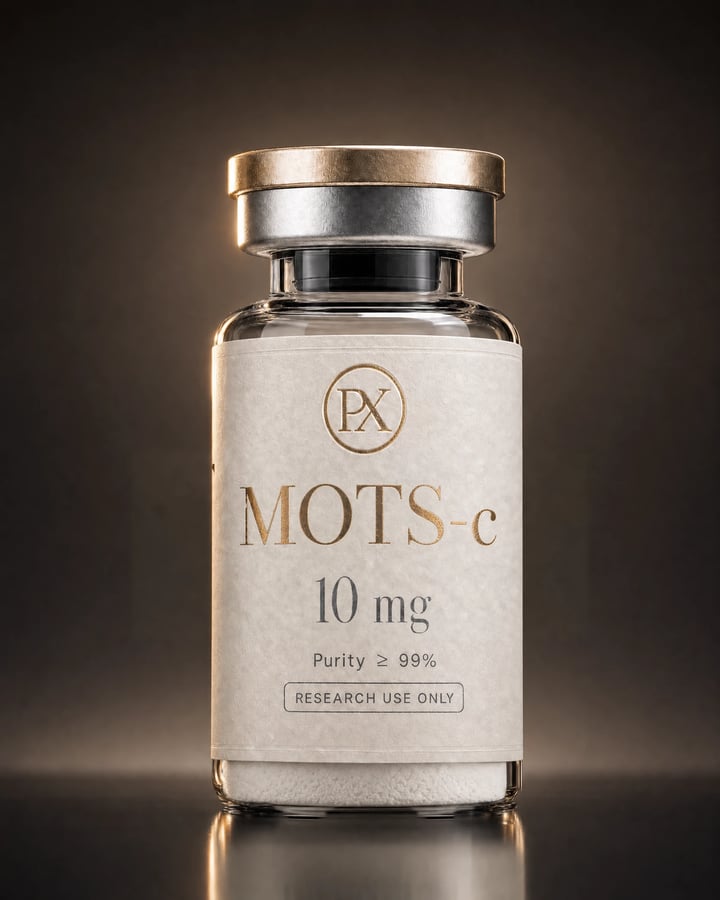
MOTS-c Single vial · Cellular Senescence Research
Strength
Volume pricing
Any mix of Express vials counts. Not combined with discount codes.
Add 1 more to unlock 5% off
Your basket is empty
With this one in, 1 vial more of anything and the whole basket is 5% off.
For laboratory research use only. Not for human or veterinary use.
Buying at volume? MOTS-c factory direct
About MOTS-c+
About MOTS-c
MOTS-c (mitochondrial open reading frame of the 12S rRNA type-c) is a 16-amino-acid peptide encoded by a short stretch of mitochondrial DNA inside the 12S ribosomal RNA gene. It was described in 2015 by Lee, Cohen and colleagues at the University of Southern California (Lee et al., Cell Metab 2015). In that study, mice given MOTS-c did not develop the insulin resistance seen with age or a high-fat diet, and gained less weight on that diet; skeletal muscle appeared to be its main target. Later mouse work reported better physical performance in young, middle-aged and old mice. In people, studies so far are observational: MOTS-c levels in muscle and blood rose after exercise (Reynolds et al., Nat Commun 2021). A modified version, CB4211, was tested in a phase 1a/1b placebo-controlled study in healthy volunteers and people with fatty liver disease (88 participants, completed 2021); no results are posted on the trial registry. A phase 2a placebo-controlled trial of MOTS-c itself was registered in 2026 and is recruiting. Most published work comes from the discovering group, and long-term human safety is unknown. Supplied for laboratory research use only.
Mechanism
In cell and mouse studies, MOTS-c inhibits the folate cycle and the linked pathway that makes purines (building blocks of DNA and RNA), which leads to activation of AMPK, an enzyme that senses cellular energy (Lee et al., 2015). Under metabolic stress such as glucose shortage, it moves into the cell nucleus and changes the activity of many genes, including antioxidant-response genes (Kim et al., Cell Metab 2018). Skeletal muscle appears to be its main target tissue in mice.
Research on MOTS-c
Storage and handling
- Reconstituted 2 to 8 C up to 30 days.
- Once reconstituted, keep refrigerated and avoid repeated freeze and thaw cycles.
- Bacteriostatic water is the usual diluent. The volume added sets the concentration in mg per mL.
- Vials carry a batch number for your laboratory records. Recent independent lab results are published in our COA Library.
FAQs
Can I order a single vial of MOTS-c without a minimum order?+
Yes. The single-vial range exists precisely so a laboratory can take one vial of MOTS-c rather than a full Factory Direct kit of 10. There is no minimum order quantity on this format.
How quickly does a MOTS-c single vial ship in the UK?+
Single vials are held in our UK facility and dispatched within 24 hours of a cleared payment on working days, on a tracked UK service. Orders placed at the weekend go out on the next working day.
How does the single vial differ from the factory-direct box?+
The compound and the manufacturing source are the same. The Factory Direct kit is a 10-vial pack and a lower per-vial cost, while the single vial is one vial from UK stock for small-scale or pilot work.
What purity is stated for MOTS-c?+
99%+ manufacturer-stated purity. Buyers are encouraged to run independent third-party verification, and our testing directory lists laboratories that perform it.
Is this MOTS-c vial for human use?+
No. Every Peptx product, including the single-vial range, is supplied strictly for laboratory research. It is not for human consumption, diagnosis, treatment or any clinical use.
What is MOTS-c?+
MOTS-c is a 16-amino-acid peptide encoded in the mitochondrial 12S ribosomal RNA gene. It was first described in 2015 by a group at the University of Southern California. It is supplied here for laboratory research use only.
How does MOTS-c work?+
In cell and mouse studies it inhibits the folate cycle and purine production, which activates AMPK, a cellular energy sensor. Under metabolic stress it also moves into the nucleus and changes the activity of many genes.
Has MOTS-c been tested in people?+
A modified version, CB4211, completed an early-phase placebo-controlled study in 2021, with no results posted on the trial registry, and a phase 2a trial of MOTS-c itself began recruiting in 2026. Other human studies measure natural MOTS-c levels, for example after exercise.
How is MOTS-c stored?+
Store the freeze-dried powder sealed, cold and away from light, following standard laboratory peptide storage procedures. See the product specifications for detailed storage requirements.
Other single vials in Cellular Senescence Research
Strictly for laboratory research. Not for human consumption, diagnosis or treatment.