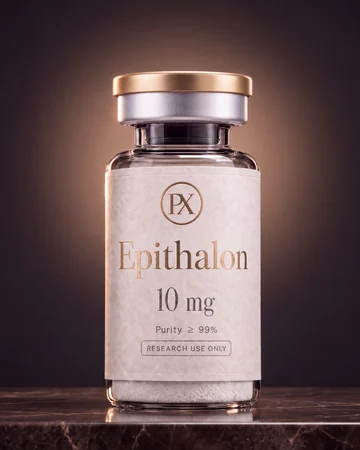
20mg× 10 vials
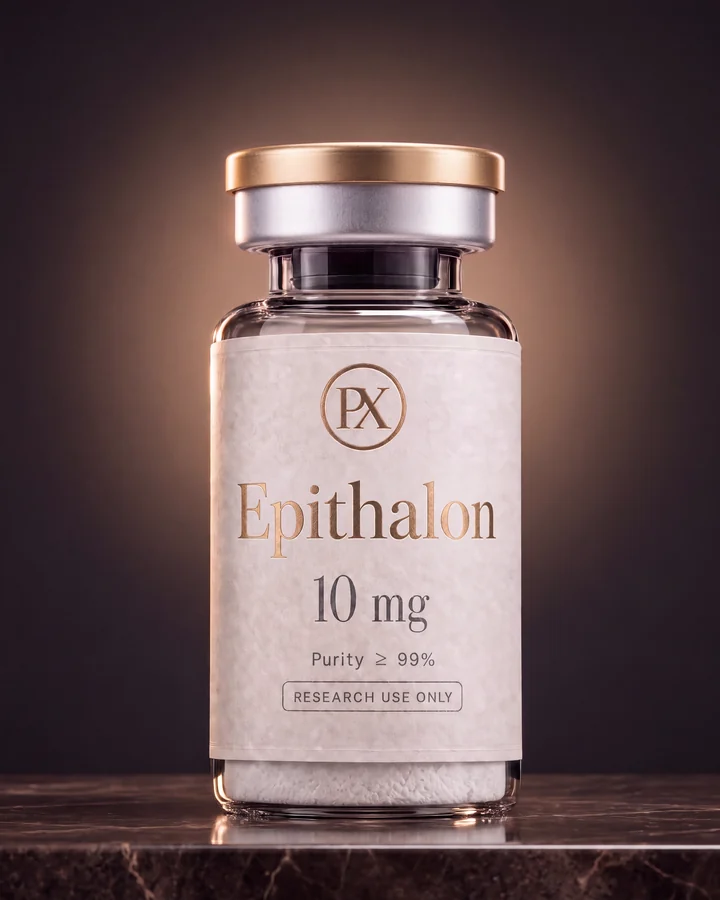
Strength
Coming soon
Price to be confirmed.
For laboratory research use only. Not for human or veterinary use.
Synthetic tetrapeptide. Studied in telomerase and circadian-rhythm research.
Guaranteed minimum purity: ≥98%. Purity Guarantee
Research areasCellular Senescence
No receptor has been identified for Epithalon. In cultured human cells it was reported to switch on the gene for telomerase (the enzyme that rebuilds chromosome ends) and lengthen telomeres, findings reported by its developers and by an independent UK laboratory (Al-Dulaimi et al., 2025). In rat pineal cell cultures the developers reported more AANAT, an enzyme in melatonin production, but a separate rat pineal study led from Paris found no change in melatonin release. The developers also propose that it binds DNA directly, based on test-tube and modelling work.
Epithalon (also spelled Epitalon; sequence Ala-Glu-Asp-Gly, or AEDG) is a synthetic tetrapeptide from Khavinson's short-peptide programme at the St Petersburg Institute of Bioregulation and Gerontology. It was designed from the amino acid make-up of Epithalamin, an extract of cattle pineal gland, and is the most published peptide of this programme. In human fetal lung cells grown in the lab, the developers reported raised telomerase activity, longer telomeres (the caps on the ends of chromosomes) and, in a later paper, extra cell divisions (Khavinson et al., 2003). An independent UK laboratory reported longer telomeres in normal human cells through telomerase, and in breast cancer cell lines through a different route called ALT (Al-Dulaimi et al., Biogerontology 2025). In a lifelong study of female mice (54 per group), average lifespan did not change, while the longest-lived tenth lived somewhat longer. A study led from Paris found no change in melatonin release from young or old rat pineal glands in the lab (Djeridane et al., 2003). Human reports come from the developers' network, mostly in Russian journals, with no published randomised placebo-controlled trials. Long-term safety and whether lab findings apply to people are not known. Supplied for laboratory research use only.
Epithalon (also spelled Epitalon) is a synthetic four-amino-acid peptide, Ala-Glu-Asp-Gly. It was designed in St Petersburg from the make-up of Epithalamin, a cattle pineal gland extract. It is supplied here for laboratory research use only.
No receptor has been identified. In cultured human cells it switched on telomerase, the enzyme that rebuilds chromosome ends, and lengthened telomeres. Its developers also report effects on a melatonin-making enzyme in rat pineal cells, though a separate study led from Paris found no change in melatonin release.
Only in studies from the developers' network, mostly published in Russian, with no published randomised placebo-controlled trials. Most evidence comes from cell cultures, rodents and fruit flies, and long-term safety in people is not known.
Store the freeze-dried powder sealed, cold and away from light, following standard laboratory peptide storage procedures. See the product specifications for detailed storage requirements.