
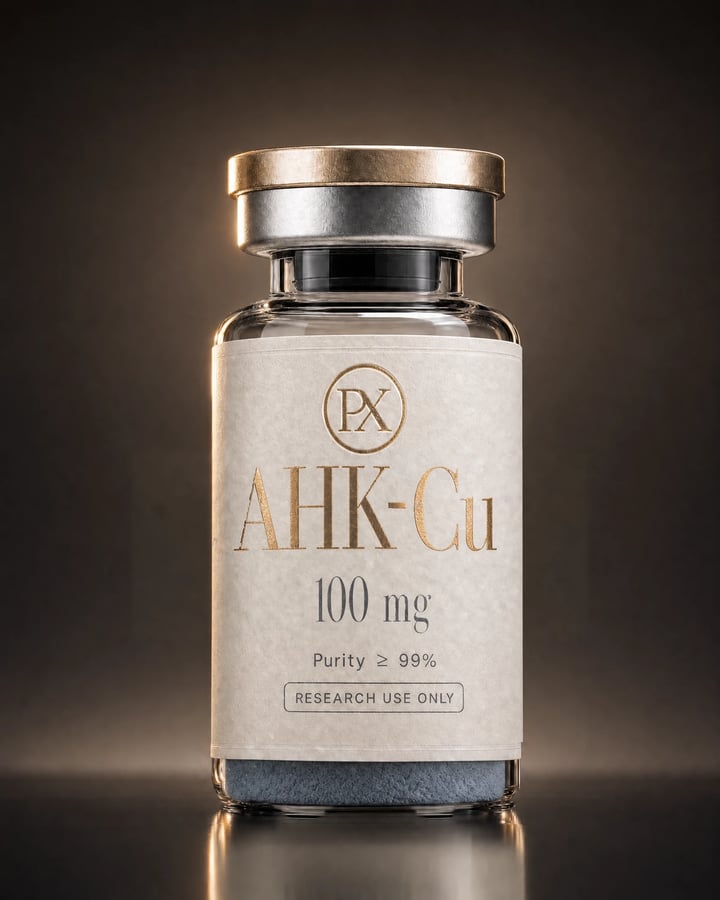
AHK-Cu Single vial · Dermatological Research
Strength
Volume pricing
Any mix of Express vials counts. Not combined with discount codes.
Add 1 more to unlock 5% off
Your basket is empty
With this one in, 1 vial more of anything and the whole basket is 5% off.
For laboratory research use only. Not for human or veterinary use.
Buying at volume? AHK-Cu factory direct
About AHK-Cu+
About AHK-Cu
AHK-Cu is a synthetic complex of the tripeptide alanine-histidine-lysine (Ala-His-Lys) with a copper ion. It differs from the better-known copper peptide GHK-Cu (glycine-histidine-lysine) by one amino acid, with alanine in place of glycine. Peptides that start with any amino acid followed by histidine, as both of these do, hold copper in a well-described way through three nitrogen atoms. Published research on AHK-Cu itself is very limited. The only study listed on PubMed is a cell and tissue culture study from the dermatology department at Seoul National University (Pyo et al., Arch Pharm Res 2007). Human hair follicles kept alive in culture grew longer when exposed to AHK-Cu, and cultured dermal papilla cells (the cells at the base of a hair follicle) multiplied more. The fall in the number of dying cells the authors measured was not statistically clear. No animal studies or human trials of AHK-Cu have been published, the findings have not been repeated by another group, and no study has compared its stability or activity directly with GHK-Cu. Supplied for laboratory research use only.
Mechanism
AHK-Cu holds a copper ion through the peptide's starting amino group, the next backbone nitrogen and the histidine side chain, the binding pattern described for peptides that start with any amino acid followed by histidine, such as GHK (Gonzalez et al., 2017). No receptor or cell target for AHK-Cu has been identified, and whether it carries copper into cells has not been shown. In the one published cell study, it raised the ratio of the cell-survival protein Bcl-2 to Bax and lowered cleaved caspase-3 and PARP, markers of programmed cell death, in cultured human dermal papilla cells (Pyo et al., 2007).
Research on AHK-Cu
Storage and handling
- Sealed and lyophilised, store at 2 to 8°C away from light and moisture. Minus 20°C for longer.
- Once reconstituted, keep refrigerated and avoid repeated freeze and thaw cycles.
- Bacteriostatic water is the usual diluent. The volume added sets the concentration in mg per mL.
- Vials carry a batch number for your laboratory records. Recent independent lab results are published in our COA Library.
FAQs
Can I order a single vial of AHK-Cu without a minimum order?+
Yes. The single-vial range exists precisely so a laboratory can take one vial of AHK-Cu rather than a full Factory Direct kit of 10. There is no minimum order quantity on this format.
How quickly does a AHK-Cu single vial ship in the UK?+
Single vials are held in our UK facility and dispatched within 24 hours of a cleared payment on working days, on a tracked UK service. Orders placed at the weekend go out on the next working day.
How does the single vial differ from the factory-direct box?+
The compound and the manufacturing source are the same. The Factory Direct kit is a 10-vial pack and a lower per-vial cost, while the single vial is one vial from UK stock for small-scale or pilot work.
What purity is stated for AHK-Cu?+
≥99% manufacturer-stated purity. Buyers are encouraged to run independent third-party verification, and our testing directory lists laboratories that perform it.
Is this AHK-Cu vial for human use?+
No. Every Peptx product, including the single-vial range, is supplied strictly for laboratory research. It is not for human consumption, diagnosis, treatment or any clinical use.
What is AHK-Cu?+
AHK-Cu is a synthetic complex of the tripeptide alanine-histidine-lysine with a copper ion. It differs from the better-known GHK-Cu by one amino acid, alanine in place of glycine. It is supplied here for laboratory research use only.
How does AHK-Cu work?+
The peptide holds copper through its starting amino group, a backbone nitrogen and the histidine side chain, as GHK does. No receptor or cell target has been identified. In one cell study it shifted markers of programmed cell death in cultured hair follicle cells.
What has been studied?+
Published work is limited to a single cell and tissue culture study, in which human hair follicles kept in culture grew longer and dermal papilla cells multiplied more when exposed to AHK-Cu (Pyo et al., 2007). No animal studies or human trials have been published, and no study has compared it directly with GHK-Cu.
How is AHK-Cu stored?+
Store the freeze-dried powder sealed, cold and away from light, following standard laboratory peptide storage procedures. See the product specifications for detailed storage requirements.
Other single vials in Dermatological Research
Strictly for laboratory research. Not for human consumption, diagnosis or treatment.