
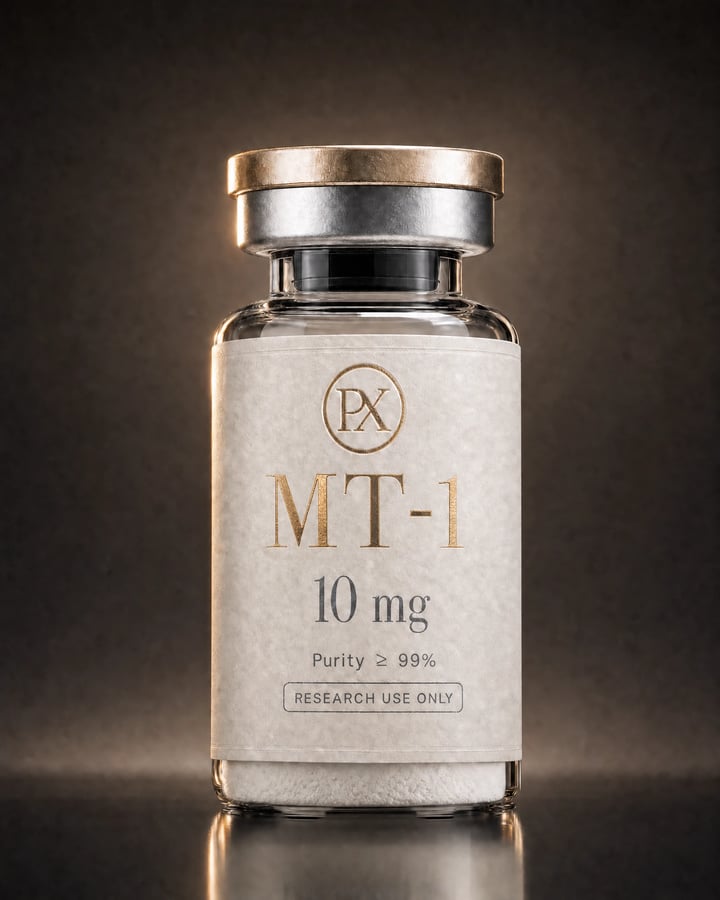
MT-1 Single vial · Melanocortin Research
Strength
Volume pricing
Any mix of Express vials counts. Not combined with discount codes.
Add 1 more to unlock 5% off
Your basket is empty
With this one in, 1 vial more of anything and the whole basket is 5% off.
For laboratory research use only. Not for human or veterinary use.
Buying at volume? MT-1 factory direct
About MT-1+
About MT-1
MT-1 (Melanotan I, afamelanotide) is a synthetic 13-amino-acid analogue of alpha-melanocyte-stimulating hormone (alpha-MSH), with two amino acids changed so that it resists breakdown by blood enzymes. It was first described in 1980 by a University of Arizona group, who found it more potent and longer-lasting than alpha-MSH in frog skin and mouse melanoma cell tests (Sawyer et al., PNAS 1980). In a randomised placebo-controlled study in 28 healthy men, it darkened the skin over the following weeks. As an implant called afamelanotide was authorised in the EU in December 2014, under exceptional circumstances, to prevent phototoxicity (light-triggered skin pain) in adults with erythropoietic protoporphyria (EPP), a rare inherited condition, and in the US in 2019 for adults with EPP. These approvals rest on two randomised placebo-controlled trials in 74 and 94 patients, with funding from the developer (Langendonk et al., NEJM 2015). Outside EPP, including a randomised trial in 55 people with vitiligo, studies are small and reviews call for larger ones. Unregulated products sold as Melanotan I and II have been linked in case reports to changes in moles. These research materials are not the licensed medicine. Supplied for laboratory research use only.
Mechanism
Afamelanotide binds melanocortin receptors, mainly MC1R, the receptor on melanocytes (the skin's pigment cells). In mouse melanoma cells it switched on adenylate cyclase, the enzyme that makes the signalling molecule cAMP, and tyrosinase, a key enzyme in melanin production. In people this shows as darker skin. Lab binding studies show it also binds the MC3 and MC4 receptors, so it is not fully selective for MC1R (Schiöth et al., 1996).
Storage and handling
- Sealed and lyophilised, store at 2 to 8°C away from light and moisture. Minus 20°C for longer.
- Once reconstituted, keep refrigerated and avoid repeated freeze and thaw cycles.
- Bacteriostatic water is the usual diluent. The volume added sets the concentration in mg per mL.
- Vials carry a batch number for your laboratory records. Recent independent lab results are published in our COA Library.
FAQs
Can I order a single vial of MT-1 without a minimum order?+
Yes. The single-vial range exists precisely so a laboratory can take one vial of MT-1 rather than a full Factory Direct kit of 10. There is no minimum order quantity on this format.
How quickly does a MT-1 single vial ship in the UK?+
Single vials are held in our UK facility and dispatched within 24 hours of a cleared payment on working days, on a tracked UK service. Orders placed at the weekend go out on the next working day.
How does the single vial differ from the factory-direct box?+
The compound and the manufacturing source are the same. The Factory Direct kit is a 10-vial pack and a lower per-vial cost, while the single vial is one vial from UK stock for small-scale or pilot work.
What purity is stated for MT-1?+
99%+ manufacturer-stated purity. Buyers are encouraged to run independent third-party verification, and our testing directory lists laboratories that perform it.
Is this MT-1 vial for human use?+
No. Every Peptx product, including the single-vial range, is supplied strictly for laboratory research. It is not for human consumption, diagnosis, treatment or any clinical use.
What is MT-1?+
MT-1, also called Melanotan I or afamelanotide, is a synthetic 13-amino-acid analogue of the pigment hormone alpha-MSH, first made at the University of Arizona in 1980. Afamelanotide is licensed in the EU and US, as an implant called for adults with erythropoietic protoporphyria, and the research material supplied here is not that medicine. It is supplied for laboratory research use only.
How does MT-1 work?+
It binds melanocortin receptors, mainly MC1R on the skin's pigment cells, which switches on cAMP signalling and the melanin-making enzyme tyrosinase. In lab binding studies it also binds the MC3 and MC4 receptors, so it is not fully selective.
What did the human trials find?+
Two randomised placebo-controlled trials in adults with erythropoietic protoporphyria, with 74 and 94 patients, measured time spent in direct sunlight without pain, and these trials underpin the EU and US approvals (Langendonk et al., 2015). Smaller trials have looked at other skin conditions such as vitiligo. Our research overview covers the details.
How is MT-1 stored?+
Store the freeze-dried powder sealed, cold and away from light, following standard laboratory peptide storage procedures. See the product specifications for detailed storage requirements.
Other single vials in Melanocortin Research
Strictly for laboratory research. Not for human consumption, diagnosis or treatment.